Collaboration and visioning at the 2026 ESIP Summer Meeting
Ronny Hernández Mora 
Julie Lowndes
Ileana Fenwick
Openscapes participates in ESIP (Earth Science Information Partners) meetings every year, and looks forward to the hybrid (in-person and virtual) meeting in July that brings together information technology professionals, teachers, and researchers to discuss about Earth science data, computing, and technology. The 2026 July Meeting was in the beautiful city of Austin, Texas (keep it weird!) from July 28 to 31, with an extra day for an Openscapes Hackday on July 27.
Through all the ESIP sessions, a couple of questions kept resurfacing: what will happen to the many tools, datasets, and products as AI changes how people interact, discover, and use scientific information? How can they work together across platforms, organizations, and people? And, probably most importantly, how can we support and sustain the people who will maintain the open infrastructure that makes all this possible? This is about the people, the organizations, and the conditions needed for open science practices to grow: from making a new idea possible to gaining institutional support to build the tools and products that can be sustained and adapted through time. This post focuses on the sessions and talks that the NASA and NOAA Openscapes Mentors led on Wednesday.
Quicklinks:
- ESIP Highlights webinar (slides, recording) - 2-min summaries from each session, organized by the ESIP team
- 2026 Sched. We led four sessions:
- Getting to Yes blog post
- Hackday blog post
Cross-posted at nasa-openscapes.github.io/news, nmfs-openscapes.github.io/blog and openscapes.org/blog.
“How was ESIP?”
When Ronny, Ileana, and Julie returned from ESIP, here were our overall summaries:.
Ronny: This was my first time attending a meeting centered on creating scientific tools and data products, and also the first time I had seen so many people openly share their questions, uncertainties, ideas, and opportunities for collaboration. Attending the meeting was also my opportunity to finally meet Ileana, Julie, and many of the NASA and NOAA colleagues I had previously known only through the world of video calls! I enjoyed hearing different perspectives on AI and considering how it might interact with the tools people use to discover, access, and analyze Earth science data. The meeting left me thinking about how much work lies behind every tool and data product—not only technical development, but also metadata, documentation, governance, maintenance, and the relationships that make collaboration possible. I left feeling curious, excited to keep learning, and thinking in ways I can contribute to the efforts!
Ileana: As a first time ESIP Summer Meeting attendee I came back excited to talk about just how different being at ESIP felt. As an academic researcher by training, conferences I have attended often bring about blank stares and tired eyes from watching presentation after presentation all day long. At ESIP, the interactive and engaging format of sessions, often inviting breakout groups and audience engagement, was a welcome and fun shakeup that left me rallying to fit as many sessions and conversations as possible into each day! What struck me the most was that ESIP has created such a dynamic and engaged community of participants that it felt like a welcome with open arms to a newcomer like myself. In addition to this warm welcome, I observed and felt an invitation to dream big. There was this incredible energy of collaboration and community amongst participants that felt like a breath of fresh air as I am dreaming of what to do next. I walked away feeling inspired, connected, and with my calendar already marked for next year!
Julie: The ESIP July Meeting is such a treat every year, a chance to see in person many people I work with on a weekly basis but always from Zoom, as well as to meet new people and folks that I only have the chance to connect with once a year. My goals this year – in addition to co-leading three official sessions plus the Monday Hackday and Social Hour – was to spend time with people. From the Openscapes Core Team, I met Ronny for the first time, and saw Ileana for the first time since we were recognized for the Year of Open Science. I liked dancing two-step with colleague-friends at an old-school honky tonk! I liked helping connect every combination of NASA and NOAA Mentors and Leadership and other ESIPers – and I tried to share specific things about why it was good for them to meet each other so that they could quickly find common interest. I have been thinking a lot about “forkable stories” – being able to copy-modify and take action based on what you’ve heard someone else do. ESIP helps make that possible.
Together, we hosted a Monday Hackday with the NASA Openscapes Mentors (see blog post: “Finding Solutions Faster by Hacking on Ideas with Openscapes at ESIP”) attended sessions throughout the week, and joined social dinners, walks to see bat roosts along the river, went two-stepping, and prepared posters for ESIP FUNding Friday – and Ileana’s pitch won, see below!
Sessions emphasizing social and technical work across government agencies
On Wednesday, NASA and NOAA Openscapes mentors presented in every time-slot, including three sessions we co-convened with NASA and NOAA Openscapes mentors. Across the sessions, one message connected the technical and social discussions: better tools and data formats matter, but their adoption depends on people having the support, trust, and opportunities needed to use and sustain them.
Closing the ARCO Adoption Gap: Modernizing Data Analysis Workflows
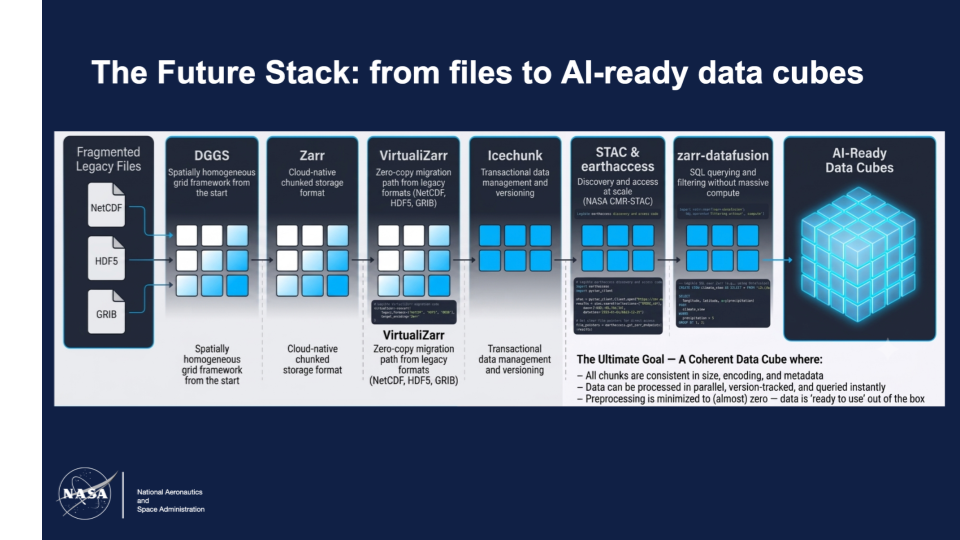
One of the topics nowadays is about workflows in the cloud. Many datasets have been adapted or created as Analysis-Ready, Cloud-Optimized (ARCO) data. This session focused on how to support people shifting from workflows that download and analyze data locally to cloud optimized workflows.
Eli Holmes (NOAA Fisheries) presented Beautiful, Barrier-Free Visualization as an Incentive for ARCO Adoption. The main idea is that showing people useful tools that are easy to use and adapt can accelerate adoption. Eli showcased an interactive visualization created with Gridlook to easily visualize data hosted as Zarr (including Icechunk) taking advantage of GitHub pages. With an open dataset, and a few lines of code on GitHub Actions, users can publish visualizations of their own or others’ compatible datasets.
Luis Lopez (NSIDC) presented From Files to Analysis: Chunking, Virtualization, and ARCO-like Access Patterns in the Cloud, sharing the evolution of archiving data, legacy constraints that dictates the shape of the units of storage, and the evolving landscape of tools. Part of the effort to adopt Modern ARCO-like workflows requires that we fix our data to make it behave like cloud optimized formats even if it’s not. Both Luis and Eli also presented in the 2-part Virtual Stores Sessions convened by Aimee Barciauskas (Development Seed).
Facilitating Scientists’ Learning While Stress Testing Open Science Principles via Openscapes
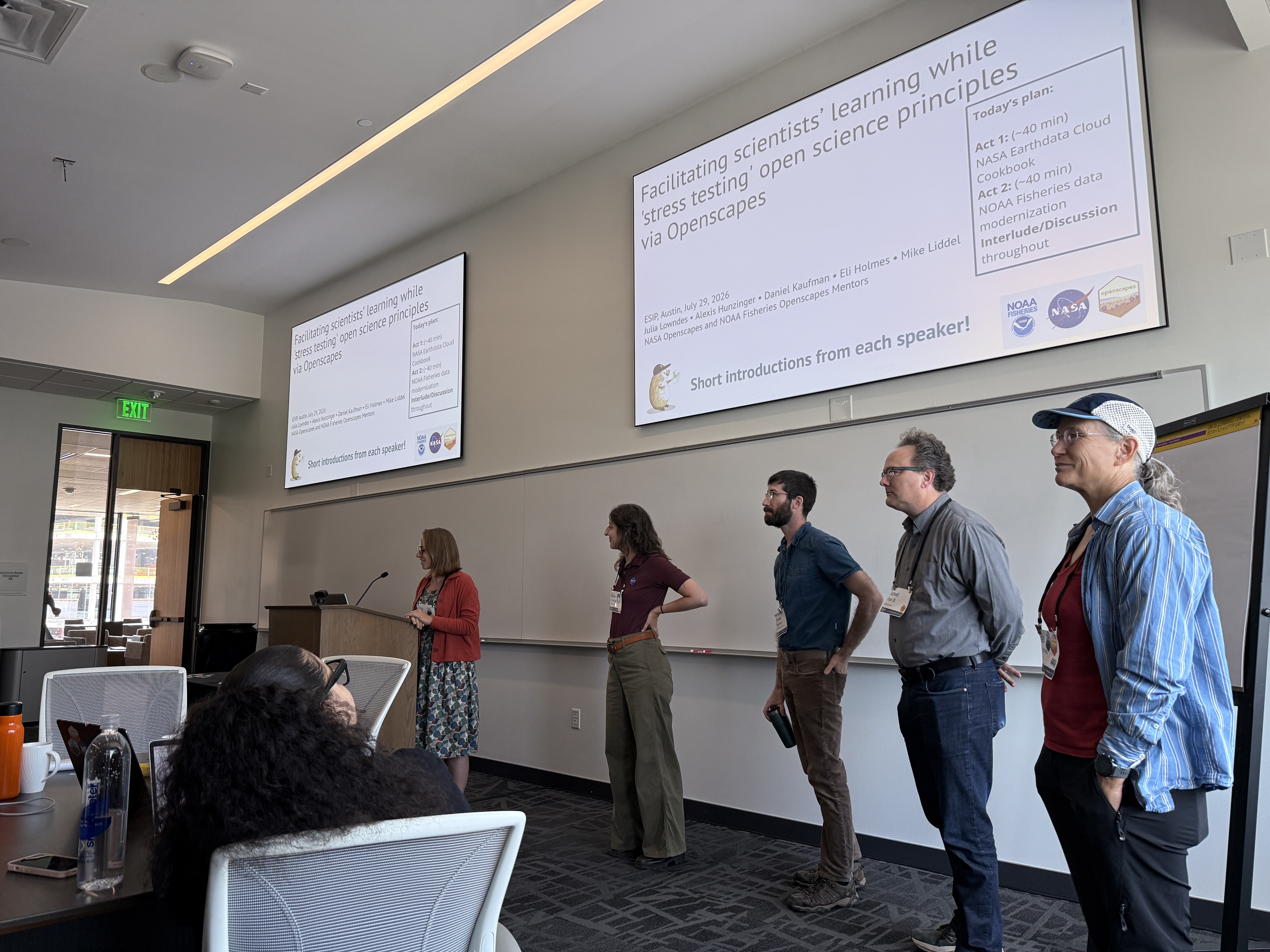
For this session we had the NASA Openscapes and NOAA Fisheries Openscapes Mentors Alexis Hunzinger (GES DISC), Daniel Kaufman (ASDC), Eli Holmes (NOAA Fisheries), and Mike Liddel (NOAA Fisheries) shared stories and observations (slides) about the process they have been going through to make progress on open science activities within the requirements of government agencies. Themes included the need to make space for collaboration. The journey to enable this has many nuances, and is not always a straight path forward.
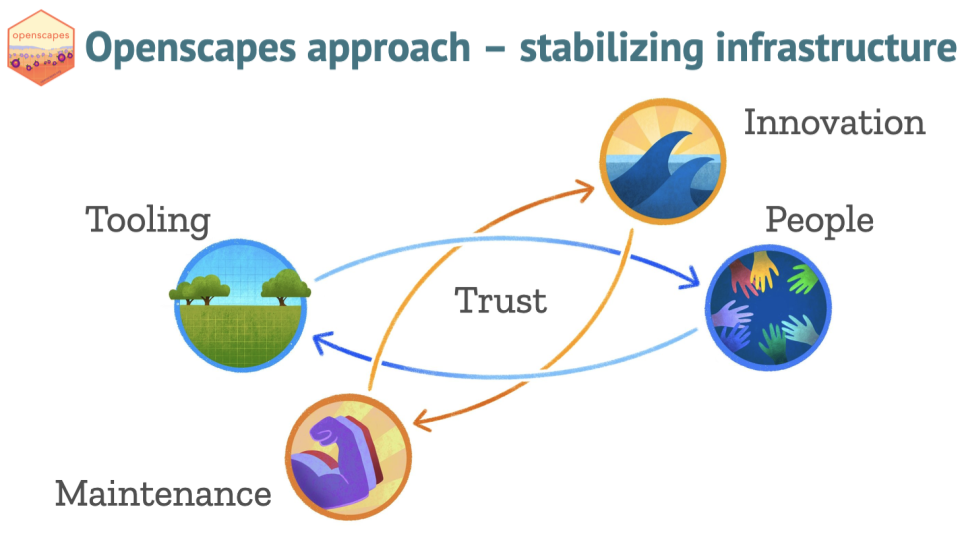
Some of the key takeaways from these stories are that the tooling around open science is also social. You need to involve people in the loop. And you can involve people when there is trust. “Open Science runs on trust”. Danny discussed how you have to make “space for serendipity”. Alexis described how there is trust and hesitation underlying the various URLs where NASA Earthdata tutorials have been available, and how this is a consideration going forward for the Cookbook. Eli shared about a listening session where they found that “making it possible” is still a big focus for folks, and relies on trust. Mike shared about including IT from the beginning on successful projects, since they are often experienced with open source work but can also be surprised by the open science outputs that researchers create. One key message is that learning does not happen in a vacuum! which means that there are prerequisites such as staff time, tools and infrastructure, IT support, leadership and student buy-in.
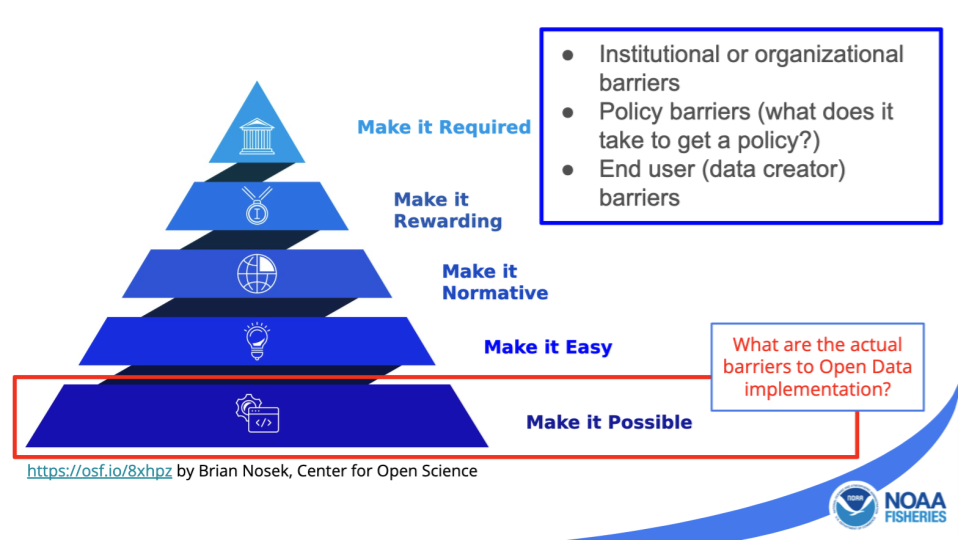
The session reflected on how progress is possible because there is a loop on which trust is involved: trust in the people, trust in the time allocated, trust in the outputs produced, trust in the process and interactions that can happen here (sometimes is not planned and is serendipity!) This progression matters because simply requiring a new practice does not guarantee meaningful adoption. People first need the time, support, and opportunity to use it successfully.
Bridging Divides and Getting to Yes
We asked Erin Robinson to develop and lead this session, and she also authored a summary blog post: Making Change: What We Learned at the ESIP Session “Bridging Divides and Getting to Yes”. Speakers Michele Thornton, Eli Holmes, Michael Liddel, Julia Lowndes shared short stories of what it looked like to “get to yes” (slides) regarding moving ideas forward.
A common pattern emerged: receiving a “no” did not necessarily mean that the idea had reached its end. Instead, it created an opportunity to step back and ask what was preventing others from saying yes. Was the request reaching the right person? Were the benefits clear? Did the proposal respond to the needs of the people who would use the tool, process, or data? Were concerns about time, resources, risk, or responsibility still unresolved? Getting to “yes,” therefore, was not simply about making the same request more forcefully. It involved understanding other perspectives, identifying the people whose support was needed, and reframing or adjusting the proposal so that its value became clearer. Sometimes the path forward was a smaller and more concrete request: permission to test an idea, time to develop a pilot, access to IT support, or an introduction to a potential collaborator.
earthaccess: Five Years of Open Source Science Leadership at NASA
Earthaccess is not only a python library – is a powerful model for open-source tool sustainability and user-driven development. It is now widely used not only because it solves real user problems, but because it has been intentionally developed openly and amplified via storytelling. This session was a celebration of 5 years of open science leadership. We shared several short stories: What is earthaccess and current impact; Why is this so widely known?; How we work: open governance; Current focus: virtualizing, AI-preparation; and Untold enabling stories. earthaccess was born out of the necessity to simplify the process of accessing the data by reducing the need to deal with different workflows, data centers, cloud object storage, credentials and so on. This session was also followup from our 2025 ESIP FUNding Friday award. Slides were presented by Ian Carroll, Amy Steiker, Danny Kaufman, Luis López, Joseph Kennedy, Julie Lowndes, Justin Rice.
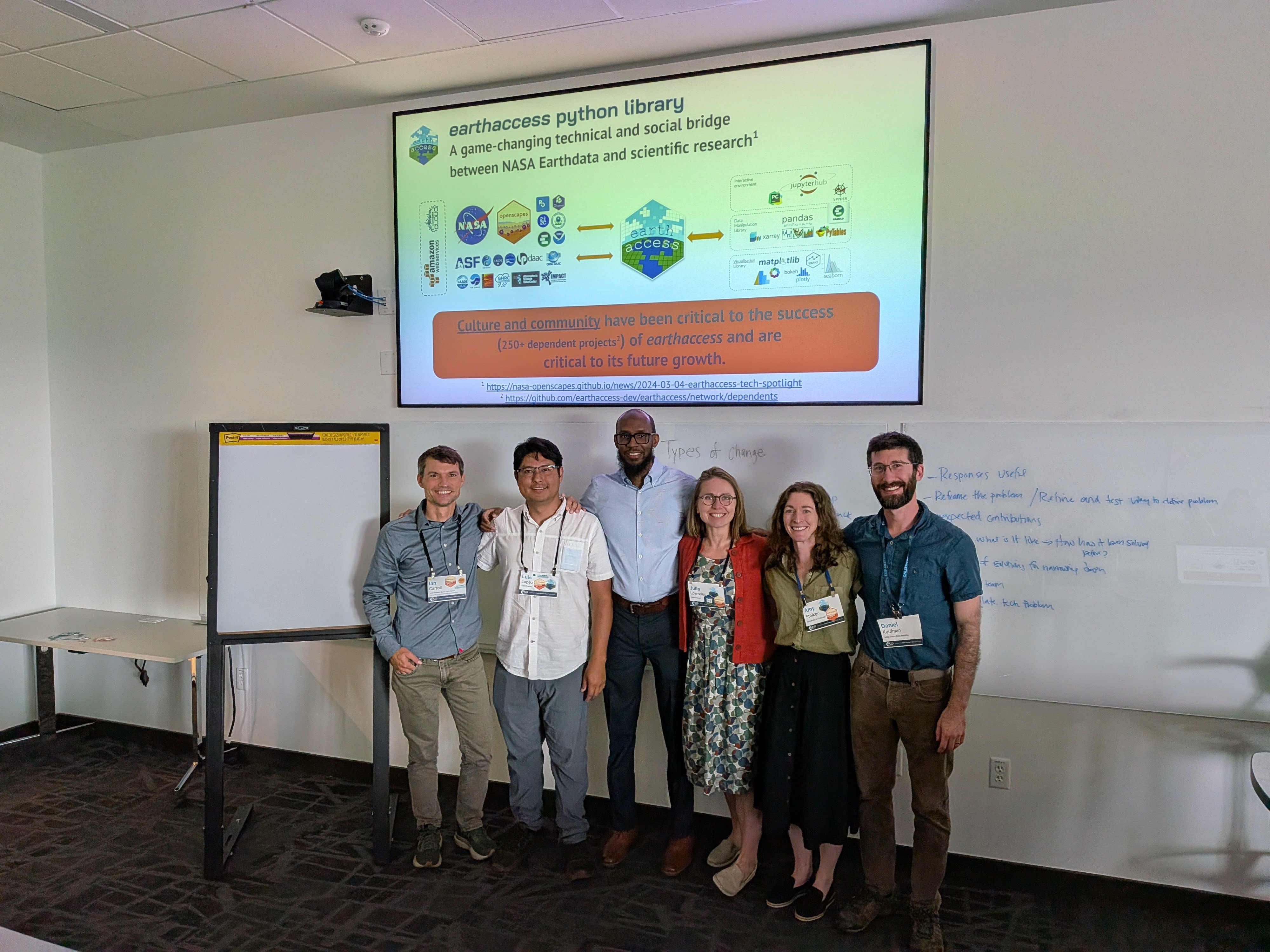
The future for earthaccess v1.0 is expanding toward virtual data sources that allow people to work with cloud-hosted data through tools such as xarray without first copying entire datasets. Its roadmap toward version 1.0 includes a stable API, performance improvements, virtual data stores, STAC interoperability, and a plugin architecture. Together, these developments show that open-source science leadership involves more than creating useful software: it requires sustained outreach, shared governance, and continued adaptation to emerging scientific needs.
Since ESIP, Andy Barrett also gave a live demo about earthaccess during an Earthdata Webinar short: Using the earthaccess Python Library to Stream Data!
Making plans for next steps after ESIP
On Thursday afternoon at ESIP, there was unconf time: open time during the event to discuss or work on something that has come up during the meeting. This year, we pitched and then used this time to vision the Openscapes Mentor community going forward at NASA Earthdata. There is an upcoming NASA Townhall this Fall where we will learn more about NASA’s plans, stay tuned as we learn more!
Winning ESIP FUNding Friday! This year our team member Ileana Fenwick won ESIP’s FUNding Friday mini-grant for $5,000 with a proposal entitled “Two stepping into student data fun!” Ileana says: we aim for this funding to support exploring how novice users approach and use for the first time open access tools and resources. A highlight of the trip was watching the idea move from a series of Slack messages to a collaborative pitch from conversation and discussion around the concept of new user experiences. Specifically, we are collaborating with earthaccess developers to test with university students, with a path for feeding the feedback directly to their team. ESIP really does know how to put the FUN in FUNding, because in this mini-grant competition the encouragement to collaborate creates a fun evening of conversation, idea iteration, and of course illustration (and for us two-stepping!) for the competition poster. We are looking forward to ESIP’s Summer Meeting in 2027 to report out!
One thought stayed with us after the meeting: no matter how much data we collect or how sophisticated our tools become, people remain at the center. It is people who use these resources to make decisions, understand our world, adapt to change, and improve quality of life. It is people who connect the data, technologies, and ideas, that progress depends on our ability to communicate, build trust, create spaces for collaboration, and learn from and teach one another. To the question, How will people using AI interact with Earth science data products? There is no single answer, but several pieces need to come together to prevent data from becoming invisible for AI tools. Technology will continue to change, but working together is how we will move forward.
Citation
@online{hernández_mora2026,
  author = {Hernández Mora, Ronny and Lowndes, Julie and Fenwick,
    Ileana},
  title = {Collaboration and Visioning at the 2026 {ESIP} {Summer}
    {Meeting}},
  date = {2026-09-09},
  url = {https://openscapes.org/blog/2026-09-09-openscapes_esip_summer_2026},
  langid = {en}
}